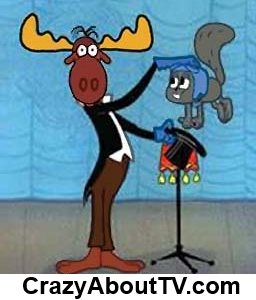
Rocky and Bullwinkle

Rocky and Bullwinkle Picture
The Rocky and Bullwinkle Show is the collective name for two separate American television animated series: Rocky and His Friends (1959 – 1961) and The Bullwinkle Show (1961 – 1964). Rocky & Bullwinkle enjoyed great popularity during the 1960s. Much of this success was a result of it being targeted towards both children and adults. The zany characters and absurd plots would draw in children, while the clever usage of puns and topical references appealed to the adult demographic. Furthermore, the strengths of the series helped it overcome the fact that it had choppy, limited animation; in fact, some critics described the series as a well-written radio program with pictures
Rocky and Bullwinkle Image
The lead characters and heroes of the series were Rocket "Rocky" J. Squirrel, a flying squirrel, and his best friend Bullwinkle J. Moose, a dim-witted but good-natured moose. Both characters lived in the fictional town of Frostbite Falls, Minnesota, which was based on the real life city of International Falls, Minnesota.[3] The scheming villains in most episodes were the fiendish, but inept, agents of the fictitious nation of Pottsylvania: Boris Badenov, a pun on Boris Godunov, and Natasha Fatale, a pun on femme fatale. Boris and Natasha were commanded by the sinister Mr. Big and Fearless Leader. Other characters included Gidney & Cloyd, little green men from the moon who were armed with scrooch guns; Captain Peter "Wrongway" Peachfuzz, the captain of the S.S. Guppy; and the inevitable onlookers, Edgar and Chauncy.
When first shown on NBC, the cartoons were introduced by a Bullwinkle puppet, voiced by Bill Scott, who would often lampoon celebrities, current events, and especially Walt Disney, whose program Disneyland was the next show on the schedule. On one occasion, "Bullwinkle" encouraged children to pull the tuning knobs off the TV set. "In that way," explained Bullwinkle, "we'll be sure to be with you next week!" After the network received complaints from parents of an estimated 20,000 child viewers who apparently followed Bullwinkle's suggestion, Bullwinkle told the children the following week to put the knobs back on with glue "and make it stick!" The puppet sequence was dropped altogether[4]. He also did a segment called "Dear Bullwinkle," where letters specially made for the show were read and answered humorously. Four episodes of, "Dear Bullwinkle," are on Season 1 DVD.
Rocky and Bullwinkle Wallpaper
Each episode comprises two "Rocky & Bullwinkle" cliffhanger shorts that stylistically emulated early radio and film serials. The plots of these shorts would combine into much larger story arcs that would span numerous episodes. For example, the first and also the longest story arc of the series was called Jet Fuel Formula and consisted of 40 shorts (20 episodes). Each story arc would place the mighty moose and plucky squirrel in a different adventure, ranging from seeking the missing ingredient for a rocket fuel formula, to tracking the monstrous whale Maybe Dick, to a desperate attempt to prevent mechanical, metal-munching, moon mice from devouring the nation's television antennas. Rocky and Bullwinkle confront a number of obstacles and enemies in the course of their adventures, most frequently the two Pottsylvanian nogoodniks, Boris Badenov and Natasha Fatale.
At the end of most episodes, the narrator, William Conrad, would announce two humorous titles for the next episode that typically were puns of each other. For example, during an adventure taking place in a mountain range, the narrator would state, "Be with us next time for 'Avalanche Is Better Than None,' or 'Snow's Your Old Man.'" The narrator also frequently had conversations with the characters, thus breaking the fourth wall in the process.(Wikipedia)
Bart Simpson ImageRocky and Bullwinkle Wallpaper

Bart Simpson PictureRocky and Bullwinkle Picture

Tom and Jerry Picture Gallery

Tom and Jerry Wallpaper
Tom and Jerry is a series of animated theatrical shorts created by William Hanna and Joseph Barbera for Metro-Goldwyn-Mayer that centered on a never-ending rivalry between a housecat (Tom) and a mouse (Jerry) whose chases and battles often involved comic violence. Hanna and Barbera ultimately wrote and directed one hundred and fourteen Tom and Jerry cartoons at the MGM cartoon studio in Hollywood, California between 1940 and 1957, when the animation unit was closed. The original series is notable for having won the Academy Awards for Best Short Subject (Cartoons) seven times, tying it with Walt Disney's Silly Symphonies as the most-awarded theatrical animated series, considered[who?] to be magnum opus of American animation industry.[citation needed]
Tom and Jerry Picture
Beginning in 1960, in addition to the originals MGM had new shorts produced by Rembrandt Films, led by Gene Deitch in Eastern Europe. Production of Tom and Jerry shorts returned to Hollywood under Chuck Jones's Sib-Tower 12 Productions in 1963; this series lasted until 1967, making it a total of 161 shorts. The cat and mouse stars later resurfaced in television cartoons produced by Hanna-Barbera and Filmation Studios during the 1970s, 1980s, and 1990s, a feature film, Tom and Jerry: The Movie, in 1992 and released domestically in 1993 and in 2000, their first TV special, Tom and Jerry in: The Mansion Cat for Cartoon Network.
Today, Time Warner (via its Turner Entertainment division) owns the rights to Tom and Jerry, and also produced the series, Tom and Jerry Tales for The CW's Saturday morning "The CW4Kids" lineup, as well as the recent Tom and Jerry short, The KarateGuard, in 2005 and a string of Tom and Jerry direct-to-video films.
he plots of each short usually center on Tom's (the cat) numerous attempts to capture Jerry (the mouse) and the mayhem and destruction that ensues. Since Tom rarely attempts to eat Jerry and because the pair actually seem to get along in some cartoon shorts it is unclear why Tom chases Jerry so much. Some reasons given may include normal feline/murine enmity, duty according to his owner, Jerry's attempt at ruining a task that Tom is entrusted with, revenge, Jerry saving other potential prey (such as ducks, canaries, or goldfish) from being eaten by Tom or competition with another cat, and attempts to seduce feline femme fatales, among other reasons.
Tom and Jerry title card used during the late 1940s and early 1950s, attached to many reissues of early and mid 1940s shorts.
Tom and Jerry Image
Tom rarely succeeds in catching Jerry, mainly because of Jerry's cleverness, cunning abilities, and luck. Interestingly enough, many of the title cards show Tom and Jerry smiling at each other which seems to depict a love-hate relationship rather than the extreme annoyance each displays towards the other in each cartoon. There are also several instances within the cartoons where they display genuine friendship ("Springtime for Thomas") and concern for each other's well-being (such as in "Jerry and the Lion" where Jerry in one instance tricks Tom into thinking he has shot Jerry, and Tom comes running with the first aid kit).
The shorts are famous for some of the most violent gags ever devised in theatrical animation: Jerry slicing Tom in half, shutting his head in a window or a door, Tom using everything from axes, pistols, explosives, traps and poison to try to murder Jerry, Jerry stuffing Tom's tail in a waffle iron, kicking him into a refrigerator, plugging his tail into an electric socket, pounding him with a mace, club or mallet, causing a tree to drive him into the ground, and so on.[1] Despite all its popularity, Tom and Jerry has often been criticized as excessively violent.[2]:42 [3]:134 Despite the frequent violence, there is no blood or gore in any scenes. A recurring gag involves Jerry hitting Tom when he's preoccupied, with Tom initially oblivious to the pain—and only feeling the effects moments later, and vice versa; and another involves Jerry stopping Tom in midchase (as if calling for a time-out), before he does something, usually putting the hurt on Tom.
The cartoon is also noteworthy for its reliance on stereotypes, such as the blackening of characters following explosions and the use of heavy and enlarged shadows (e.g., Dr. Jekyll and Mr. Mouse). Resemblance to everyday objects and occurrences is arguably the main appeal of visual humor in the series. The characters themselves regularly transform into ridiculous but strongly associative shapes, most of the time involuntarily, in masked but gruesome ways.
Tom and Jerry Picture
Music plays a very important part in the shorts, emphasizing the action, filling in for traditional sound effects, and lending emotion to the scenes. Musical director Scott Bradley created complex scores that combined elements of jazz, classical, and pop music; Bradley often reprised contemporary pop songs, as well as songs from MGM films, including The Wizard of Oz and Meet Me In St. Louis. Generally, there is little dialogue as Tom and Jerry almost never speak, however minor characters are not similarly limited. For example, the character Mammy Two Shoes has lines in every episode in which she appears except The Little Orphan. Most of the dialogue from Tom and Jerry are the high-pitched laughs and gasping screams, which may be provided by a horn or other musical instrument.
Before 1954, all Tom and Jerry cartoons were produced in the standard Academy ratio and format; from late 1954 to 1955, some of the output was dually produced in both Academy format and the widescreen CinemaScope process. From 1956 until the close of the MGM cartoon studio a year later, all Tom and Jerry cartoons were produced in CinemaScope, some even had their soundtracks recorded in Perspecta Stereo. The 1960s Gene Deitch and Chuck Jones shorts were all produced in Academy format, but with compositions that made them compatible to be matted to Academy widescreen format as well. All of the Hanna and Barbera cartoons were produced in three-strip Technicolor; the 1960s entries were done in Metrocolor.
Tom and Jerry Poster
om is a Russian Blue cat, who lives a pampered life, while Jerry is a small brown house mouse who always lives in close proximity to him. "Tom" is a generic name for a male cat or tomcat (the Warner Bros. cartoon character Sylvester was originally called "Thomas"). Tom was originally called "Jasper" in the very first short, Puss Gets the Boot, while Jerry was unnamed, though the animators gave him the nickname "Jinx".
Tom is very quick-tempered and thin-skinned, while Jerry is independent and opportunistic. Jerry also possesses surprising strength for his size, lifting items such as anvils with relative ease and withstanding considerable impacts with them. Despite being very energetic and determined, Tom is no match for Jerry's brains and wits. By the final "iris-out" or "fade-out" of each cartoon, Jerry usually emerges triumphant, while Tom is shown as the loser. However, other results may be reached; on rare occasions, Tom triumphs, usually when Jerry becomes the aggressor or when he crosses some sort of line (the best example of which occurs in The Million Dollar Cat where, after finding out that Tom's newly acquired wealth will be taken away if he harms any animal, including a mouse, he torments Tom until Tom finally loses his temper and attacks him). Sometimes, usually ironically, they both lose or they both end up being friends (only for something to happen so that Tom will chase Jerry again). Both characters display sadistic tendencies, in that they are equally likely to take pleasure in tormenting each other. However, depending on the cartoon, whenever one character appears to be in mortal danger (in a dangerous situation or by a third party), the other will develop a conscience and save him. Sometimes, they bond over a mutual sentiment towards an unpleasant experience and their attacking each other is more play than serious attacks. Multiple shorts show the two getting along with minimal difficulty, and they are more than capable of working together when the situation calls for it, usually against a third party who manages to torture and humiliate them both. In one short, Tom shows genuine concern for Jerry when he believes that he has accidentally shot him and immediately rushes to get a first-aid kit.
Despite several shorts depicting Tom's apparent "death" at the end of the short, he never actually dies throughout the series, and even reads about a flashback of his own apparent death in Jerry's Diary.
Tom and Jerry Wallpaper
Although many supporting and minor characters speak, Tom and Jerry rarely do so themselves. Tom, most famously, sings while wooing female cats; for example, Tom sings Louis Jordan's "Is You Is Or Is You Ain't My Baby" in the 1946 short Solid Serenade. In a couple of shorts, Tom, when romancing a female cat, woos her in a French-accented voice similar to that of screen actor Charles Boyer. Co-director William Hanna provided most of the squeaks, gasps, and other vocal effects for the pair, including the most famous sound effects from the series, Tom's leather-lunged scream (created by recording Hanna's scream and eliminating the beginning and ending of the recording, leaving only the strongest part of the scream on the soundtrack) and Jerry's nervous gulp. The only other reasonably common vocalization is made by Tom when some external reference claims a certain scenario or eventuality to be impossible, which inevitably, ironically happens to thwart Tom's plans - at which point, a bedraggled and battered Tom appears and says in a haunting, echoing voice "Don't you believe it!", a reference to some famous World War II propaganda shorts of the 1940's. In one episode, Tom hires a mouse exterminator who, after several failed attempts to dispatch Jerry, changes profession to Cat exterminator by crossing out the "Mouse" on his title and writing "Cat", resulting in Tom spelling out the word out loud before reluctantly pointing at himself. One short, 1956's Blue Cat Blues, is narrated by Jerry in voiceover (voiced by Paul Frees). Both Tom and Jerry speak more than once in the 1943 short The Lonesome Mouse. Tom and Jerry: The Movie is the first (and so far only) installment of the series where the famous cat-and-mouse duo regularly speak to both humans and other anthropomorphic animals; it is possible that Tom and Jerry do have full speech capabilities, but choose not to use them aside from a few short phrases, preferring to leave the talking to other characters.(Wikipedia)
Tom and Jerry ImageTom and Jerry Image

Tom and Jerry WallpaperTom and Jerry Wallpaper

Image of Bart Simpson

Bart Simpson Picture
Bartholomew "Bart" JoJo Simpson is a fictional main character in the animated television series The Simpsons and part of the eponymous family. He is voiced by actress Nancy Cartwright and first appeared on television in The Tracey Ullman Show short "Good Night" on April 19, 1987. Bart was created and designed by cartoonist Matt Groening while he was waiting in the lobby of James L. Brooks' office. Groening had been called to pitch a series of shorts based on Life in Hell but instead decided to create a new set of characters. While the rest of the characters were named after Groening's family members, Bart's name was an anagram of the word brat. After appearing on The Tracey Ullman Show for three years, the Simpson family received their own series on Fox, which debuted December 17, 1989.
At ten years of age, Bart is the eldest child and only son of Homer and Marge, and the brother of Lisa and Maggie. Bart's most prominent character traits are his mischievousness, rebelliousness and disrespect for authority. He has appeared in other media relating to The Simpsons—including video games, The Simpsons Movie, The Simpsons Ride, commercials, and comic books—and inspired an entire line of merchandise.
In casting, Nancy Cartwright originally planned to audition for the role of Lisa, while Yeardley Smith tried out for Bart. Smith's voice was too high for a boy, so she was given the role of Lisa. Cartwright found that Lisa was not interesting at the time, so instead auditioned for Bart, which she thought was a better role. Hallmarks of the character include his chalkboard gags in the opening sequence; his prank calls to Moe the bartender; and his catchphrases "Eat my shorts", "¡Ay, caramba!", and "Don't have a cow, man!"
Bart Simpson Photo
During the first two seasons of The Simpsons (1989–1991), Bart was the show's breakout character and "Bartmania" ensued. Bart Simpson T-shirts sporting various slogans and catchphrases became popular, selling at a rate of a million per day at their peak. The song "Do the Bartman" became a number one charting single and the seventh best-selling song of 1991 in the United Kingdom. Bart's rebellious attitude and pride at underachieving caused many parents and educators to cast him as a bad role model for children. A T-shirt reading "I'm Bart Simpson. Who the hell are you?" was banned in several public schools. Around the third season, the series started to focus more on the family as a group, although Bart remains one of the most prominent characters on the series. Time named Bart one of the 100 most influential people of the 20th century, and he was named "entertainer of the year" in 1990 by Entertainment Weekly. Nancy Cartwright has won several awards for voicing Bart, including a Primetime Emmy Award in 1992 and an Annie Award in 1995. In 2000, Bart, along with the rest of his family, was awarded a star on the Hollywood Walk of Fame.
Bart Simpson Wallpaper
The Simpsons uses a floating timeline in which the characters do not age, and as such the show is always assumed to be set in the current year. In several episodes, events have been linked to specific times, though sometimes this timeline has been contradicted in subsequent episodes. Bart's year of birth was stated in "I Married Marge" (season three, 1991) as being in the early 1980s. He lived with his parents in the Lower East of Springfield until the Simpsons bought their first house. When Lisa was born, Bart was at first jealous of the attention she received, but he soon warmed to her when he discovered that "Bart" was her first word. Bart's first day of school was in the early 1990s. His initial enthusiasm was crushed by an uncaring teacher and Marge became worried that something was truly wrong with him. One day during recess, Bart met Milhouse and started entertaining him and other students with various gestures and rude words. Principal Skinner told him "you've just started school, and the path you choose now may be the one you follow for the rest of your life! Now, what do you say?" In his moment of truth, Bart responded, "eat my shorts". The episode "That 90's Show" (season nineteen, 2007) contradicted much of the backstory; for example, it was revealed that Homer and Marge were childless in the early 1990s.
Bart's various hobbies include skateboarding, watching television (especially The Krusty the Clown Show which includes the The Itchy & Scratchy Show), reading comic books (especially Radioactive Man), playing video games and generally causing mischief. For the duration of the series, Bart has attended Springfield Elementary School and has been in Edna Krabappel's fourth grade class. While he is too young to hold a full-time job, he has had occasional part time jobs. He works as a bartender at Fat Tony's social club in "Bart the Murderer" (season three, 1991); as Krusty the Clown's assistant in "Bart Gets Famous" (season five, 1994); and briefly owns his own factory in "Homer's Enemy". (season eight, 1997)
Bart Simpson WallpaperBart Simpson Wallpaper

Bart Simpson ImageBart Simpson Image

Daffy Duck Image Gallery

Daffy Duck Wallpaper
Daffy Duck is an animated cartoon character in the Warner Brothers Looney Tunes and Merrie Melodies series of cartoons. Daffy was the first of the new breed of "screwball" characters that emerged in the late 1930s to supplant traditional everyman characters, such as Mickey Mouse and Popeye, who were more popular earlier in the decade. Daffy is known as the best friend and occasionally self-imagined rival of Bugs Bunny.
Virtually every Warner Brothers animator put his own spin on the Daffy Duck character, who may be a lunatic vigilante in one short but a greedy gloryhound in another. Bob Clampett and Chuck Jones both made extensive use of these two very different versions of the character.
In Spanish language versions of his cartoons, he is known as Lucas.
Daffy first appeared on April 17, 1937, in Porky's Duck Hunt, directed by Tex Avery and animated by Bob Clampett. The cartoon is a standard hunter/prey pairing for which Leon Schlesinger's studio was famous, but Daffy (barely more than an unnamed bit player in this short) represented something new to moviegoers: an assertive, combative protagonist, completely unrestrainable. As Clampett later recalled, "At that time, audiences weren't accustomed to seeing a cartoon character do these things. And so, when it hit the theaters it was an explosion. People would leave the theaters talking about this daffy duck."
Daffy Duck Picture
This early Daffy is less anthropomorphic and resembles a 'normal' duck. The Mel Blanc voice characterization and the white neck ring contrasting with the black feathers, are about the only aspects of the character that remained consistent through the years. Blanc's characterization of Daffy holds the world record for the longest characterization of one animated character by his or her original actor — 52 years. Daffy's catchphrase is "you're despicable."
Daffy Duck is a black duck with an orange bill and feet. He occasionally wears cowboy clothes like blue jeans, a cowboy hat, boots, a bandana, and a button shirt.
The origin of Daffy's voice is a matter of some debate. One oft-repeated "official" story is that it was patterned after producer Schlesinger's tendency to lisp. However, in Mel Blanc's autobiography, That's Not All Folks!, he contradicts that conventional belief, writing "It seemed to me that such an extended mandible would hinder his speech, particularly on words containing an s sound. Thus 'despicable' became 'desthpicable'."
Daffy Duck Photo
Daffy's slobbery, exaggerated lisp was developed over time, being barely noticeable in the early cartoons. In Daffy Duck and Egghead, Daffy does not lisp at all, except in the separately-drawn set-piece of Daffy singing "The Merry Go Round Broke Down", in which just a slight lisp can be heard.
Blanc's early version of Daffy was actually closer to his characterization of Woody Woodpecker than any other voice. In time he developed the slobbery, lispy sound, supposedly based on Warner cartoon producer Leon Schlesinger, that was essentially the same voice as Sylvester the Cat except that it was played back at a faster-than-recorded speed. (Incidentally, Sylvester's voice was actually Mel Blanc's own voice, plus the heavily exaggerated, slobbery lisp for which Sylvester and Daffy are famous for.) In one of the features on the Looney Tunes Golden Collection DVD set, there is a rare audio of Blanc discussing a set of recordings he is about to make for the 1960s TV program, The Bugs Bunny Show. In that audio he states, "We record Daffy separately, because his voice is sped." In his later years, Mel would claim — and in personal appearances would even perform — separate voices for the cat and duck. In the DVD commentary for Scrap Happy Daffy, narrator Greg Ford reported that Blanc had once told him he sometimes played Daffy as if he were a Jewish comic, while playing Sylvester as if he were Gentile.(Wikipedia)
Daffy Duck PhotoDaffy Duck Photo

Daffy Duck WallpaperDaffy Duck Wallpaper

Cartman Cartoon Series

Eric Theodore Cartman, commonly referred to by his family name, Cartman, is one of the four main fictional characters on the animated television series South Park, along with Stan, Kyle, and Kenny. Cartman is the series' main antagonist, villain and antihero. He is voiced by series co-creator Trey Parker. He is always seen with a double chin.
Cartman PhotoCartman Photo

Cartman WallpaperCartman Wallpaper

Cartman PictureCartman Picture