Yogi Bear

Yogi Bear Wallpaper
Yogi Bear is a fictional anthropomorphic bear who appears in animated cartoons created by Hanna-Barbera Productions. He made his debut in 1958 as a supporting character in The Huckleberry Hound Show. He was the first break-out character created by Hanna-Barbera Studios, and was eventually more popular than Huckleberry Hound. In 1961 he was given his own show, The Yogi Bear Show, which also included the segments Snagglepuss and Yakky Doodle. Hokey Wolf replaced his segment on The Huckleberry Hound Show. A musical animated feature film, Hey There, It's Yogi Bear!, was produced in 1964.

Yogi was one of several Hanna-Barbera characters to have a collar, which allowed the body to be kept static and to redraw just the head in each frame when he was speaking, thus reducing the number of drawings needed for a seven-minute cartoon from 14,000 to around 2,000.
Yogi Bear Image
In October 2008, it was announced that Warner Bros. will film a live-action/animated version similar to Fox and Bagdasarian's Alvin & the Chipmunks.
Like many Hanna-Barbera characters, Yogi's personality and mannerisms were based on a popular celebrity of the time. Art Carney's Ed Norton character on The Honeymooners was said to be Yogi's inspiration. Yogi's name is a nod to the famed baseball star Yogi Berra, though Hanna and Barbera denied this intent. The plot of most of Yogi's cartoons centered on his antics in the fictional Jellystone Park, a takeoff on the famous Yellowstone National Park. Yogi, accompanied by his reluctant best friend Boo Boo, would often try to steal picnic baskets from campers in the park, much to the chagrin of Park Ranger Smith. A girlfriend, Cindy Bear, turned up sometimes, and usually disapproved of Yogi's antics.
Yogi Bear and Boo Boo CartoonYogi Bear and Boo Boo Cartoon

Yogi Bear WallpaperYogi Bear Wallpaper

Yogi Bear PictureYogi Bear Picture

Spongebob Picture Gallery

Spongebob Wallpaper
Through-out the run of SpongeBob SquarePants, the SpongeBob character has become very popular with both children and adults. The character's popularity has spread from Nickelodeon's original demographic of two to eleven year olds, to teenagers and adults, including college campuses and celebrities such as Sigourney Weaver and Bruce Willis. Salon.com indicates that the unadulterated innocence of SpongeBob is what makes the character so appealing. SpongeBob has also become popular with gay men, despite Stephen Hillenburg saying that none of the characters are homosexual. The character draws fans due to his flamboyant lifestyle and tolerant attitude, and he is seen as a gay icon.
Spongebob Picture
The popularity of SpongeBob translated well into sales figures. In 2002, SpongeBob SquarePants dolls sold at a rate of 75,000 per week, which was faster than Tickle Me Elmo dolls were selling at the time. SpongeBob has gained popularity in Japan, specifically with Japanese women. The Japanese market is seen as a significant market to break into.[18] Nickelodeon's parent company Viacom purposefully targeted marketing at women in the country as a method of building the SpongeBob SquarePants brand. Sceptics initially doubted that SpongeBob could be popular in Japan as the character's design is very different to already popular designs for Hello Kitty and Pikachu.

Not all reception for SpongeBob has been positive. AskMen's Top 10: Irritating '90s Cartoon Characters ranked SpongeBob at number four. The publication said that his well meaning attitude is extremely annoying.

Spongebob PictureSpongebob Picture

Spongebob ImageSpongebob Image

Spongebob PosterSpongebob Poster

Elmer Fudd Picture

Elmer Fudd Wallpaper
Elmer J. Fudd is a fictional cartoon character and one of the most famous Looney Tunes characters. He has one of the more disputed origins in the Warner Brothers cartoon pantheon (second only to Bugs Bunny himself). His aim is to shoot Bugs, but he usually ends up seriously injuring himself. He has a speech sound disorder that makes his tongue slur.
In 1937, Tex Avery introduced a new character in his cartoon short Egghead Rides Again. Elmer's friendly ancestor Egghead has a bulbous nose, funny/eccentric clothing, a voice like Joe Penner, and an egg-shaped head. Many cartoon historians believe that Egghead evolved into Elmer over a period of a couple of years. Egghead made his second appearance in 1937's Little Red Walking Hood and then in 1938 teamed with Warner Brothers' newest cartoon star Daffy Duck in Daffy Duck and Egghead.
Elmer Fudd Picture
Egghead continued to appear in a string of cartoons in 1938: The Isle of Pingo Pongo, Cinderella Meets Fella, and A-Lad-In Bagdad. In A Feud There Was (1938) Egghead made his entrance riding a motorscooter with the words "Elmer Fudd, Peacemaker" displayed on the side, the beginning of that name. Egghead alternates from having a Moe Howard haircut to being bald and wearing a brown derby, a baggy suit, and a high-collared shirt. His voice, laugh, and mannerisms are very much like those of Joe Penner. Egghead is thought to be the prototype of Elmer Fudd. Egghead himself returned decades later in the compilation film Daffy Duck's Quackbusters. More recently, he also made a cameo appearance at the end of Looney Tunes: Back in Action and was also given in his own story, which starred him alongside Pete Puma, in the Looney Tunes comic book.
Egghead has the distinction of being the very first recurring character created for Leon Schlesinger's Merrie Melodies series (to be followed by such characters as Sniffles, Inki, and even Bugs Bunny), which had previously contained only one-shot characters, although during the Harman-Ising era, Foxy, Goopy Geer, and Piggy each appeared in a few Merrie Melodies.
Elmer Fudd Image
In the 1939 cartoon Dangerous Dan McFoo, a new voice actor Arthur Q. Bryan was hired to provide the voice of the hero dog-character and it was in this cartoon that the popular "milk-sop" voice of Elmer Fudd was created. Elmer Fudd has long since remained the antagonistic force in many of the Bugs Bunny cartoons. Egghead was voiced by Mel Blanc, later Cliff Nazarro and finally Arthur Q. Bryan. Later he is voiced by Joe Alaskey, then Tom Kane and finally Billy West.
In 1940, Egghead/Elmer's appearance was refined giving him a chin and a less bulbous nose (although still wearing Egghead's clothing) and Arthur Q. Bryan's "Dan McFoo" voice in what most people consider Elmer Fudd's first true appearance: a Chuck Jones short entitled Elmer's Candid Camera. The Bugs Bunny prototype drives Elmer insane. Later that year, he appeared in Friz Freleng's Confederate Honey (where he's called Ned Cutler), The Hardship of Miles Standish and Jones' Good Night Elmer where his voice and Egghead-like appearance were still the same. Jones would use this Elmer one more time, in 1941's Elmer's Pet Rabbit. The other title character here is labelled as Bugs Bunny, but is also identical to his counterpart in Camera. In the interim, the two starred in A Wild Hare. Bugs appears with a carrot, New York accent, and "What's Up, Doc?" catchphrase all in place for the first time, although the voice and physique are as yet somewhat off. Elmer has a better voice, a trimmer figure and his familiar hunting clothes. He is much more recognizable as the Elmer Fudd of later cartoons than Bugs is here.
Elmer Fudd Cartoon
Elmer's role in these two films, that of would-be hunter, dupe and foil for Bugs, would remain his main role forever after, and although Bugs Bunny was called upon to outwit many more worthy opponents, Elmer somehow remained Bugs' classic nemesis, despite (or because of) his legendary gullibility, small size, short temper, and shorter attention span. Somehow knowing not only that Elmer would lose, but knowing how he would lose, made the confrontation, counterintuitively, more delicious. Despite being the antagonist, Elmer lacked the malice of a true villain.
Elmer was usually cast as a hapless big-game hunter, armed with a double-barreled shotgun and creeping through the woods "hunting wabbits." In a few cartoons, though, he assumed a completely different persona — a wealthy industrialist type, occupying a luxurious penthouse, or, in one episode involving a role reversal, a sanitarium — which Bugs would of course somehow find his way into.
Several episodes featured Elmer differently. One (What's Up, Doc?, 1950) has Bugs Bunny relating his life story to a biographer, and recalling a time which was a downturn for the movie business. Elmer Fudd is a well-known entertainer who, looking for a new partner for his act, sees Bugs Bunny (after passing caricatures of many other famous 1940s actors who, like Bugs, are also out of work). Elmer and Bugs do a one-joke act cross-country, with Bugs dressed like a pinhead, and when he does not know the answer to a joke, Elmer gives it and hits him with a pie in the face. Bugs begins to tire of this gag and pulls a surprise on Fudd, answering the joke correctly and bopping Elmer with a mallet, which prompts the man to point his rifle at Bugs. The bunny asks nervously: "Eh, what's up doc?", which results in a huge round of applause from the audience. Bugs tells Elmer they may be on to something. According to this account, the common Elmer-as-hunter episodes are entirely staged.
One episode where Bugs "lost" in the hunting was Hare Brush (1956). Here, Elmer has been committed to an insane asylum because he believes he is a rabbit. Bugs Bunny enters Fudd's room and Elmer bribes him with carrots, then leaves the way the real rabbit entered. Bugs acts surprisingly (for him) naïve, assuming Elmer just wanted to go outside for a while. Elmer's psychiatrist arrives, and thinking Fudd's delusion has affected his appearance, drugs Bugs and conditions him into believing that he is Elmer Fudd ("I am Elmer J. Fudd, millionaire. I own a mansion and a yacht") after which Bugs starts wearing hunting clothes and acting like Elmer, hunting the rabbit-costumed Fudd, who is in turn acting like Bugs. Their hunt is cut short when Bugs is arrested, as Elmer Fudd is wanted for tax evasion. After Bugs is hauled away, Fudd breaks the fourth wall and tells the audience, "I may be a scwewy wabbit, but I'm not going to Alcatwaz."
Elmer Fudd has occasionally appeared in other costumes, notably as Cupid. He tries to convince Bugs about love, but Bugs is reluctant, thinking to himself "Don't you look like some guy who's always after me?" and pictures the Elmer in hunter's clothes. The Cupid Elmer plots to get even with Bugs, using his love arrows to make Bugs fall in love with an artificial rabbit at a dog track. Elmer also appeared in this form opposite Daffy Duck in The Stupid Cupid (1944).(Wikipedia)
Elmer Fudd PhotoElmer Fudd Photo

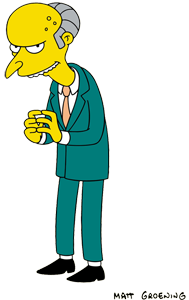
Montgomery Burns Cartoon Gallery

Montgomery Burns Image
Charles Montgomery "Monty" Burns, usually referred to as Mr. Burns, is a recurring fictional character and antagonist in the animated television series The Simpsons, who is voiced by Harry Shearer and previously Christopher Collins. Mr. Burns is the often antagonistic owner of the Springfield Nuclear Power Plant and Homer Simpson's boss. He is attended to at almost all times by Waylon Smithers, his loyal and sycophantic aide, advisor, confidant and secret admirer.
Although he was originally designed as a one-dimensional, recurring villain who might occasionally enter the Simpsons' lives and wreak some sort of havoc, Burns' popularity has led to his repeated inclusion on the show. He embodies a number of characteristics about Corporate America, as he has an unquenchable desire to increase his own wealth and power. Mr. Burns also embodies the stereotype of a manager: he forgets his employees' names (especially Homer, despite the fact that they seem to interact on a daily basis) and is unconcerned for their safety and well-being. His age provides the writers a character with which to express dated humor and references to popular culture before the 1950s. His aspirations to apply obsolete technology to everyday life or references to Victorian era people or places provide a common source of humor on the show.
Montgomery Burns Picture
His trademark expression is the word "Excellent", muttered slowly in a low, sinister voice while tenting his fingertips. He also frequently orders Smithers to "release the hounds", resulting in his vicious guard dogs attacking any intruders or enemies. Mr. Burns is Springfield's richest and most powerful citizen; within the show his current net worth is $996 million. He uses his power and wealth to do whatever he wants, usually without regard for consequences and without interference from the authorities. These qualities led Wizard Magazine to rate him the 45th greatest villain of all time.
Burns's character, appearance, and mannerisms are based on several different persons. The show's creator Matt Groening principally based Burns on Fredrik Olsen, a reclusive Norwegian shipping magnate and the owner of Timex. Drawing further inspiration from oil tycoon John D. Rockefeller and fictional character Henry Potter from It's a Wonderful Life, Groening made Burns the "embodiment of corporate greed".
Montgomery Burns Wallpaper
Animator David Silverman parodied Burns's appearance on Fox founder Barry Diller, and modeled his body on a praying mantis. The idea of Burns reading employee names off cards in "There's No Disgrace Like Home" came from an article about Ronald Reagan that writer Al Jean had read. In some episodes, parallels have been drawn between Burns and moguls such as Howard Hughes and, more frequently, fictional character Charles Foster Kane from Citizen Kane. Writer George Meyer lifted Burns's "Excellent!" hand gesture from his former Saturday Night Live colleague Jim Downey.
Matt Groening got Burns's middle name from a Montgomery Ward department store in Portland, Oregon's Northwest Industrial district[18] and his surname from Burnside Street, a main thoroughfare in downtown Portland.[14] Burns's first name being Charles is a reference to Charles Foster Kane.[14] In the script for "There's No Disgrace Like Home", Al Jean and Mike Reiss referred to him as "Mr. Meanie".
In the second season, the writers started to enjoy writing about Smithers and Burns's relationship, and they often pitched episodes with them as the focus, but many never came to fruition. (Wikipedia)
Montgomery Burns Cartoon WallpaperMontgomery Burns Cartoon Wallpaper

Montgomery Burns PhotoMontgomery Burns Photo

Montgomery Burns PosterMontgomery Burns Poster

Image of Stewie Griffin

Stewie Griffin Image
Stewart Gilligan "Stewie" Griffin is a fictional character in the animated series Family Guy. Stewie is obsessed with world domination and matricide, and has an ambiguous sexual orientation. He is the youngest child of Peter and Lois Griffin. In addition to siblings Chris and Meg, Stewie has a half-brother Bertram who is unknown to the other Griffins. Stewie is voiced by Seth MacFarlane and speaks in an affected British accent.
Stewie is one year old and has a sophisticated attitude. He reached his first birthday in the season 1 episode "Chitty Chitty Death Bang", and has remained the same age ever since. Strangely, he talks to Brian about events that happened years ago, although this can be considered normal in Family Guy given that, for example, in "A Picture Is Worth a 1,000 Bucks" Brian claims he knew Andy Warhol who died in 1987. His nature and mannerisms are juxtaposed with typical childlike interests and actions. While highly literate and able to cite pop culture references that date much further back than his age would let on, he is also entranced by Raffi and the Teletubbies. Stewie succumbs to other weaknesses of children his age — he believes Peter has truly disappeared in a game of Peek-a-Boo, believes that Peter actually takes his nose away, talks to his teddy bear (Rupert) as if he were alive, is overcome with laughter when Lois blows on his stomach, and has no idea how to use the toilet. MacFarlane has stated that Stewie is meant to represent the general helplessness of an infant through the eyes of an adult.
Per cartoon physics, his ability to move objects of greater weight than himself is not surprising to other characters, nor is his ability to retrieve firearms from hammerspace.
Stewie Griffin Picture
Stewie's mastery of physics and mechanical engineering are at a level of science fiction. He has constructed advanced fighter-jets, a mind control device, a weather control device, robots, and a time machine. Stewie employs these to cope with the stresses of infant life (such as teething pain, and eating hated broccoli) and to murder his mother Lois, with mixed success at best depending on the objective.
In other episodes, Stewie engages in other violent or criminal acts, including robbery, carjacking, loan sharking, forgery, and killing off many minor characters.
Stewie has been obsessed with his mother's extermination since the beginning of the show, and has commented several times on the subject to other people, such as when he is being interviewed when the family become part of a reality show; "It's not really that I want to kill her... it's just that I want her not to be alive... any more." His matricidal tendencies are primarily as a result of her constantly (and unknowingly) getting in the way of his evil plans, so he desires to kill her so he can carry out his plans without interference. His attempts are always fruitless in the end, usually resulting from various unfortunate circumstances getting in the way, such as her opening a cupboard door as he attempts to blow a poison dart at her, or simply moving out of the way when he is about to shoot her with a crossbow.
In the Star Wars parody episode "Blue Harvest", Peter imagines Stewie in the role of Darth Vader, which would match his darker personality, although this version of Vader is portrayed as wisecracking and sarcastic to match the show's comedic style. In "The Former Life of Brian", Stewie expresses disappointment at having his face painted as a "kitty-cat", rather than in the likeness of Darth Maul, a Dark Lord of the Sith seen in Star Wars Episode I: The Phantom Menace. Stewie often seems amused when he notices or creates destruction.
Stewie Griffin Wallpaper
Stewie eventually realizes his dreams of matricide and world domination in the sixth season two-part episode "Stewie Kills Lois" and "Lois Kills Stewie". The events, however, are reverted in a deus ex machina ending, where most of the story turns out to be a computer simulation. Because of the rather disastrous ending for himself in the simulation, he decides to put his plans of matricide and world domination aside for the time being.
Despite his evil, Stewie does seem to have a human side. For example, in "Chick Cancer", when Brian unwittingly makes a racist comment while the two of them are discussing Stewie's "marriage" to Olivia Fuller, Stewie is openly disgusted by it. When Brian profusely apologizes, Stewie leaves, saying, "You gotta work on that. Bad dog."(Wikipedia)
Stewie Griffin WallpaperStewie Griffin Wallpaper

Stewie Griffin PhotoStewie Griffin Photo