Betty Boop Cartoons

Betty Boop
Betty Boop is an animated cartoon character designed by Grim Natwick, appearing in the Talkartoon and Betty Boop series of films produced by Max Fleischer and released by Paramount Pictures. With her overt sexual appeal, Betty was a hit with filmgoers, and despite having been toned down in the mid-1930s, she remains popular today. She has been featured in two different comic strips, one in the 1930s and another in the 1980s.
Betty Boop made her first appearance on August 9, 1930 in the cartoon Dizzy Dishes, the sixth installment in Fleischer's Talkartoon series. She was originally designed by Grim Natwick, a veteran animator of the silent era who would become lead director and animator for the Ub Iwerks and Walt Disney studios. The character was modeled after a combination of Helen Kane, the famous popular singer of the 1920s and contract player at Paramount Pictures (the studio that distributed Fleischer's cartoons), and Clara Bow, who was a popular actress in the 1920s who had not managed to survive the transition to sound because of her strong Brooklyn accent which nevertheless became a trademark for Betty. By direction of Dave Fleischer, Natwick designed the original character in the mode of an anthropomorphic French poodle. The character's voice was first performed by Margie Hines, and was later provided by several different voice actresses including Kate Wright, Ann Rothschild (a.k.a. Little Ann Little), Bonnie Poe, and most notably, Mae Questel who began in 1931 and continued with the role until 1938.
While the original design was rather ugly and awkward, she was developed further after Natwick's departure under Berny Wolf, Seymour Kneitel, Roland Crandall, and Willard Bowsky. Betty became finalized as completely human by 1932 in the cartoon Any Rags. Her floppy poodle ears became hoop earrings, and her black poodle nose became a girl's button-like nose. Betty appeared in ten cartoons as a supporting character, a flapper girl with more heart than brains. In individual cartoons she was called "Nancy Lee" and "Nan McGrew", usually served as a girlfriend to studio star Bimbo.
Although it has been assumed that Betty's first name was established in the 1931 Screen Songs cartoon Betty Co-ed, this "Betty" was an entirely different character. Though the song may have led to Betty's eventual christening, any references to Betty Co-ed as a Betty Boop vehicle are incorrect. (The official Betty Boop website describes the titular character as a "prototype" of Betty.) In all, there were at least 12 Screen Songs cartoons that featured either Betty Boop or a similar character.
Betty Boop Wallpaper
Betty appeared in the first "Color Classic" cartoon 'Poor Cinderella', her only theatrical color appearance (1934). In a cameo appearance in the feature film Who Framed Roger Rabbit (1988), in her traditional black and white, and voiced by Mae Questel, Betty mentioned that work had "gotten slow since cartoons went to color," but she still had "what it takes."
Betty Boop became the star of the Talkartoons by 1932, and was given her own series in that same year beginning with Stopping the Show. From this point on, she was crowned "The Queen of the Animated Screen." The series was hugely popular throughout the 1930s, lasting until 1939.
Betty Boop's films found a new audience when Paramount sold them for syndication in 1955. U.M.&M. and National Telefilm Associates were required to remove the original Paramount logo from the opening and closing as well as any references to Paramount in the copyright line on the main titles. However, the mountain motif remains on some television prints, usually with a U.M.&M. copyright line, while recent versions have circulated with the Paramount-Publix reference in cartoons from 1931.
A display of Betty Boop collectibles.
The original "Betty Boop" cartoons were in black and white. And as newer product made for television began to appear, her cartoons were soon retired, particularly with the arrival of color television in the 1960s. But Betty's film career saw a major revival in the release of "The Betty Boop Scandals of 1974", and became a part of the post 1960s counterculture movement. NTA attempted to capitalize on this with a new syndication package, but there was no market for cartoons in black and white. As an answer, they had them remade cheaply in Korea, but were unable to sell them due largely to sloppy production that belied the quality of the originals. Unable to sell them to television, they assembled a number of the color cartoons in compilation feature titled, Betty Boop for President to capitalize on the 1976 election. But it saw no major theatrical release, and resurfaced in 1981 on HBO under the title, Hurray for Betty Boop.
Betty Boop Picture
It was the advent of Home Video that created an appreciation for films in their original versions, and Betty was rediscovered again in Beta and VHS versions. The ever expanding cable television industry saw the creation of American Movie Classics, which showcased a selection of the original black and white "Betty Boop" cartoons in the 1990s, which led to an eight volume VHS set, "Betty Boop, the Definitive Collection." To date, no official DVD releases have been made in spite of the tremendous interest. In spite of this, there are currently 22 public domain Betty Boop cartoons available at the Internet Archive.
Marketers rediscovered Betty Boop in the 1980s, and "Betty Boop" merchandise has far outdistanced her exposure in films, with many not aware of her as a cinematic creation. Much of this current merchandise features the character in her popular, sexier form, and has become popular worldwide once again. The 1980s, rapper, Betty Boo (whose voice, image and name were influenced by the cartoon character) rose to popularity in the UK largely due to the "Betty Boop" revival.
There were brief returns to the theatrical screen. In 1988, Betty appeared after a 50 year absence with a cameo in the Academy Award-winning film Who Framed Roger Rabbit. In 1993, producers Steven Paul Leiva ("Space Jam") and Jerry Rees, best known for writing and directing The Brave Little Toaster, began production on a new Betty Boop feature film for The Zanuck Company and Metro-Goldwyn-Mayer. The script by Rees detailed Betty's rise in Hollywood in the Golden Age of Hollywood. It was to be a musical with music and lyrics by jazzman Bennie Wallace. Wallace had completed several songs and seventy-five percent of the film had been storyboarded, when, two weeks before voice recording was to begin with Bernadette Peters as Betty, the head of MGM, Alan Ladd, Jr., was replaced by Frank Mancuso, and the project was abandoned.
Ownership of the Boop cartoons has changed hands over the intervening decades due to a series of corporate mergers, acquisitions and divestitures (mainly involving Republic Pictures and the 2006 corporate split of parent company Viacom into two separate companies). As of 2008, Lions Gate Home Entertainment (under license from Paramount) holds home video rights and CBS Television Distribution retains television rights. Ironically, Paramount continues to hold theatrical distribution rights, although any sort of video or theatrical re-release has yet to be announced. But the "Betty Boop" character and trademark is currently owned by Fleischer Studios, with the merchandising rights licensed to King Features Syndicate.
The Betty Boop series continues to be a favorite of many critics, and the 1933 Betty Boop cartoon Snow White (not to be confused with Disney's 1937 film Snow White) was selected for preservation by the U.S. Library of Congress in the National Film Registry in 1994. Betty Boop's popularity continues well into present day culture, with references appearing in the comic strip Doonesbury, where the character B.D.'s busty girlfriend/wife is named "Boopsie" and the animated reality TV spoof Drawn Together, where Betty is the inspiration for Toot Braunstein. A Betty Boop musical is in development for Broadway, with music by David Foster.(wikipedia)
Betty Boop CartoonsBetty Boop Cartoons

Robotboy British Animated Television Series

Robotboy Poster
Robotboy is a British/French co-produced animated television series which is produced by French production company Alphanim with TV Channels France 3 and Cartoon Network as well as Luxanimation. It was created and designed by Jan Van Rijsselberge and was directed in Alphanim's studio in Paris by Charlie Bean, who worked on other programs such as The Adventures of Jimmy Neutron: Boy Genius for Nickelodeon and Camp Lazlo for Cartoon Network. It was first aired in the United Kingdom on 1 November 2005 on Cartoon Network. The pilot episode premiered in the United States on 28 December 2005 as part of a "sneak peek" preview week for the network's new Saturday morning cartoon lineup that debuted on 14 January 2006.
Robotboy is the latest creation of the world renowned scientist Professor Moshimo. Due to fears that Robotboy would be stolen by his arch-enemy Dr. Kamikazi and his main henchman Constantine to be used to take over the world, Professor Moshimo entrusts Robotboy to 10-year-old Tommy Turnbull, his biggest fan. While being protected by Tommy and his two friends Lola and Gus, or "G-man" as he calls himself, Robotboy learns how to behave and act as if he were a real boy.
Robotboy Gallery
Most of the time, Robotboy has blue drums protruding diagonally on either side of the head. While Superactivated, they become horns. Deactivated and Activated forms look very much the same, except the deactivated form's head drums are withdrawn into the head, and his limbs are also withdrawn into his body. While activated, Robotboy has mechanical tentacles concealed in his palms and thrusters on the soles of lower part of his leg, enabling him to fly. While Superactivated, Robotboy's fists and feet and head are much larger and now have all kinds of lasers, homing missiles and machine guns. Briefly seen is an ink spray that can identify invisible targets and, of course, dramatically increased physical strength. Robotboy's most common Superactivated weapon is the machine gun arm. Many random weapons appear, and many are rarely seen twice, even in the same episode.
It also seems Robotboy is amphibious. In later episodes robotboy receives an unbreakable metal for his body to be made. This becomes seen as robotboy never takes damage.
The Activation controls for Robotboy are built into a special, orange watch that Tommy wears. The watch is in the shape of Activated Robotboy's head. In the episode "Robot Rebels", Robotboy smashes the watch after being tricked by Kamikazi. It is unknown how Tommy gets another watch, but it is safe to presume that Professor Moshimo had a spare one.
Robotboy, since he is a boy, had many cute designs on him throughout the show. (small voice, sparkle in his teeth, twinkle in his eye, etc.)(wikipedia)
Robotboy British Animated Television SeriesRobotboy British Animated Television Series

Jenny and Robot BoyJenny and Robot Boy

Robot Boy CartoonRobot Boy Cartoon

Batfink Cartoon Animated Television Series

Batfink Wallpaper
Batfink is an animated television series, consisting of five-minute shorts, that first aired in September 1967. The 100-episode series was quickly created by Hal Seeger, starting in 1966, to parody the popular Batman and The Green Hornet television series which had premiered the same year.
The cartoon was produced at Hal Seeger Studios, in New York City, and at Bill Ackerman Productions in Midland Park, New Jersey. It was syndicated by Screen Gems and continued to air on local stations throughout the 1980s. Nickelodeon briefly aired episodes of Batfink on its Weinerville and Nick in the Afternoon series in the 1990s. In September 2006, it returned to the U.S. as part of "Cartoons Without a Clue", Boomerang's mystery lineup on weekends.
The Batfink series was very popular in the UK, becoming a cult series like the later DangerMouse, and from 1967 onwards was shown at least once every year on UK terrestrial television up until 1983, initially on the BBC network where it was allocated an early evening slot just before the BBC News started, and latterly as part of Children's ITV; it subsequently reappeared in 1986 on the ITV Saturday morning magazine show Get Fresh. In the early 1990s it was repeated again as part of TV-am's Wide Awake Club/Wacaday series; after Wacaday finished in 1992, Batfink was consigned to the vaults in the UK for the next twelve years. It was introduced to a new audience in 2004 when it was included in a number of episodes of the BBC's Saturday morning show Dick and Dom in da Bungalow, and since April 2006 has been enjoying an extended, if somewhat irregular, repeat run on CBBC.
Batfink was made quickly and cheaply by re-using many common scenes to the series, instead of having to re-animate almost identical scenes for each episode. Although most serial animations do this to some extent, Batfink did it more than most. Commonly repeated scenes include the intro to the initial briefings by the Chief (the TV screen hotline buzzing into life), Batfink and Karate getting into the Battillac, the Battillac going round mountain bends, the Battillac going over a bridge, Batfink's radar and others.
Some scenes were reused every episode, some appeared sporadically and some were only repeated once or twice out during the entire series. Often, a scene would be used in more than one scenario, e.g. the Battillac going over a bridge on their way to get to a crime would also be reused during a chase scene or when they are looking all over the country for a specific item or person. Sometimes the repeated scenes would be cut short so that only sections of them could be re-used to fit the storyline more closely.(wikipedia)
Batfink Cartoon Animated Television SeriesBatfink Cartoon Animated Television Series

Batfink Popular CartoonBatfink Popular Cartoon

BatfinkBatfink

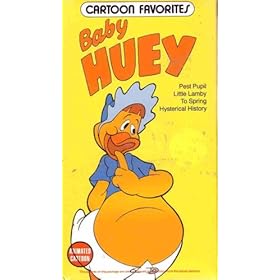
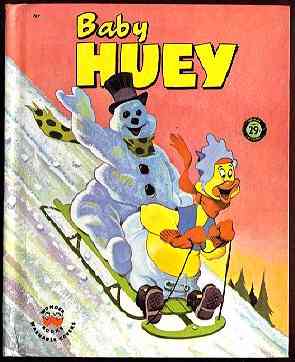
Baby Huey The Baby Giant

Baby Huey Picture
Huey's official first appearance was in Quack a Doodle Doo, a Famous Studios cartoon directed by Isadore Sparber, which was released on March 3, 1950. It set the tone for many to come, with Huey, a very large duckling, triumphing over a hungry fox by dint of his superior bulk and clumsiness. Huey's voice was provided by Syd Raymond, also the voice of the same studio's Katnip. (The family situation, so reminiscent of the Jones cartoons, became more prominent later.)
Huey continued to appear in Famous Studios cartoons, directed by Sparber, Seymour Kneitel or Dave Tendlar, until Famous sold the character, along with Little Audrey, Herman & Katnip and all the others it owned, to its then-current comic book licensor, Harvey Comics. The last Baby Huey cartoon they released was Pest Pupil, directed by Tendlar, which came out on January 25, 1957.
Harvey was the second comics publisher to license the Famous Studios characters, including Huey. The first, St. John Publishing Co., put out only one comic with Huey in it — Casper the Friendly Ghost #1 — but that comic, dated September 1949, has the distinction of containing the real first appearance of Baby Huey. Apparently, the story was prepared from advance production materials, enabling it to appear on the stands months before Huey's first cartoon hit theaters. That's an odd distinction Huey shares with Disney's José Carioca and Donald Duck's nephews.
Baby Huey Photo
Harvey took over the Famous Studios license in 1952, and made Huey a part of its anthology comic, Paramount Animated Comics. With its seventh issue (February, 1954), Huey became its permanent cover feature and his logo appeared larger than the comic's actual title. From #9 on, Huey's logo almost crowded the original off. Paramount Animated Comics ended with its July, 1956 issue. The first issue of Huey's own comic, Baby Huey the Baby Giant, was cover dated September of that year.
After buying the Famous Studios characters, Harvey began to produce cartoons of their own for the TV market. Huey has been animated several times in the ensuing years, and can sometimes be seen in out-of-the-way time slots on out-of-the-way channels. The most recent was a 1994 syndicated series, produced by Carbuncle Studios. His main venue in all this time has been the comic books.
The comic thrived during the 1950s and '60s, spinning off such ancillary titles as Baby Huey & Papa (1962-68) and Baby Huey Duckland (1962-66). It faltered during the '70s, but managed, in fits and starts, to make it to 1980. After another brief sputter in 1990, it finally bit the dust. The character uttered one last gurgle in comics during the late 1990s, when he made regular appearances in a magazine devoted to the Harvey characters; but that magazine, too, is no more.
Huey was last seen in a very low-budget, live action feature-length film, which was released direct to video in 1998. The future could be more of the same, or it could be — who knows? The company says it has plans for the character, but doesn't say anything specific about what they are.
Baby Huey Cartoon FavoritesBaby Huey Cartoon Favorites

Baby Huey The Baby GiantBaby Huey The Baby Giant

The Fairly OddParents Popular Cartoon

The Fairly OddParents
The Fairly OddParents is an American animated television series created by Butch Hartman about the adventures of Timmy, a 10-year-old boy with large buck-teeth who has two fairy godparents and, more recently, a fairy godbrother.
t is produced by Frederator Studios, for the cable network Nickelodeon, where it is currently one of the most popular shows (second only to SpongeBob SquarePants). The television series is also distributed outside the United States by the Canadian animation company Nelvana, the same as Danny Phantom (also created by Hartman).
The show makes heavy use of satire and slapstick, and is full of pop culture references. The show is currently airing its seventh season.
In Dimmsdale, California (As revealed in the episode "Christmas Everyday",and "Fairy Idol"), a ten-year-old boy named Timmy Turner was granted fairy godparents after his evil baby sitter Vicky and dimwitted parents made him miserable. His teacher, Mr. Crocker, in contrast with other adults in the series, firmly believes in fairy godparents and has been searching for them for a very long time. Crocker had fairy godparents but lost them. Mr. Crocker is dangerous to Timmy because according to Da Rules (a large rulebook that contains rules of what children can and cannot wish for), if the child reveals that he has fairies, or if someone discovers their fairies, they will lose the fairies forever. Jorgen Von Strangle (a parody of Arnold Schwarzenegger), an enormous and tough fairy, personally dislikes Timmy and his fairies, although, in "Teeth for Two" he claims Cosmo and Wanda are his closest friends.
Fairly Odd Parents displays the quote "Be Careful What You Wish For cause' You Just Might Get IT All!" It explains this point very well using a young boy named Timmy. He is accompanied by two Fairies through out his many journies and mischevoius adventures. They grant his every wish.(wikipedia)
The Fairly OddParents Popular CartoonThe Fairly OddParents Popular Cartoon

The Fairly OddParents Popular AnimeThe Fairly OddParents Popular Anime

The Fairly OddParents CartoonThe Fairly OddParents Cartoon